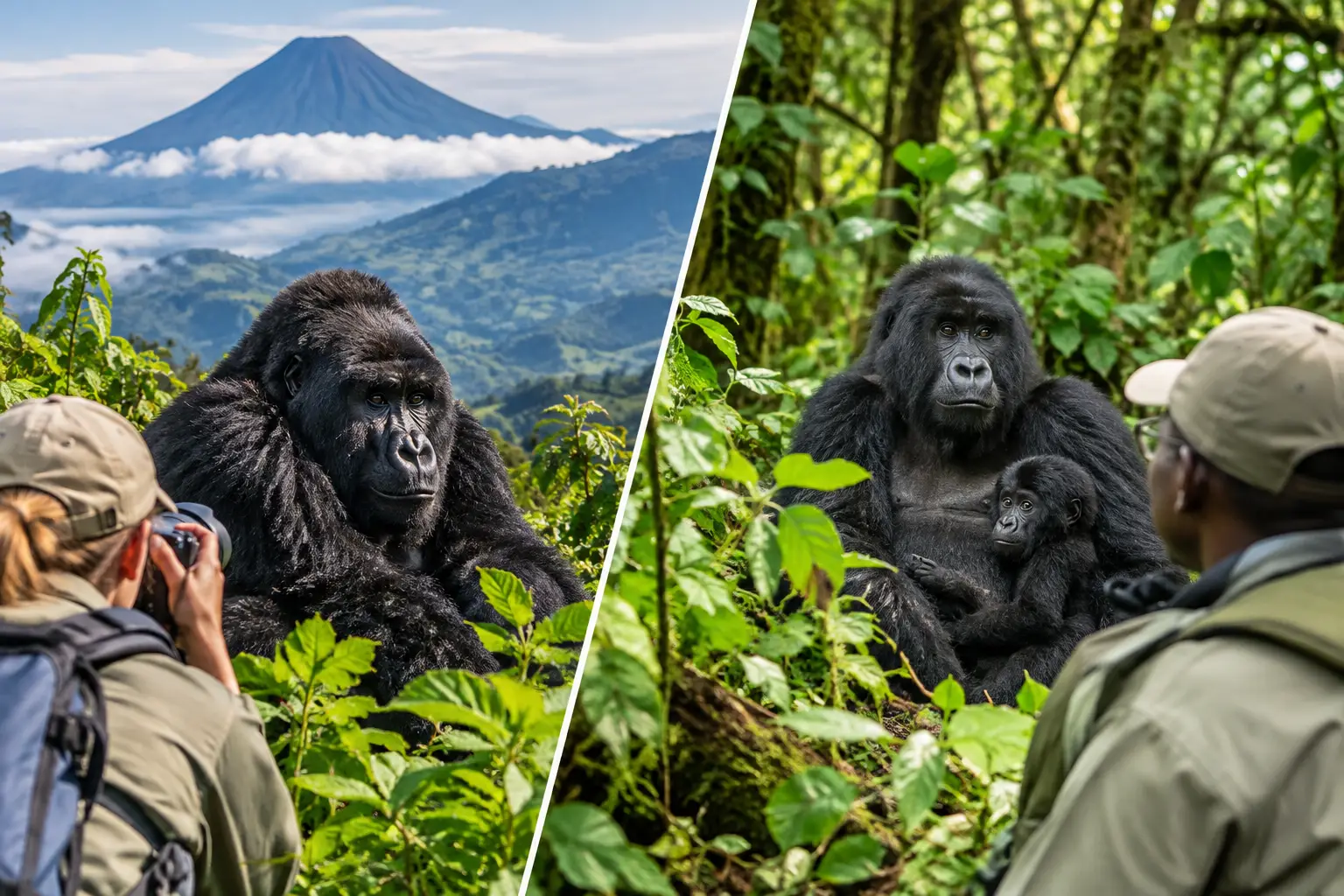
A Rwanda versus Uganda decision is rarely about choosing the better gorilla trek. Both countries offer the rare privilege of spending time with habituated mountain gorillas in their forest home. The real question is how you want that encounter to feel within the wider rhythm of your African journey: polished and concentrated, or expansive and richly varied.
For travelers pairing East Africa with a Botswana safari, the distinction matters. Gorilla trekking is physically demanding, emotionally powerful, and best enjoyed when the routing, accommodation, pace, and recovery time have been considered as carefully as the wildlife itself.
Rwanda versus Uganda at a Glance
Rwanda is often the natural choice for travelers who value efficient access, refined lodges, and a short, high-impact primate extension. Volcanoes National Park lies within a few hours’ drive of Kigali, allowing a well-designed itinerary to move from international arrival to the Virunga foothills with minimal overland travel. The setting is dramatic: bamboo forest, volcanic slopes, mist, and a strong sense of purpose around gorilla conservation.
Uganda offers greater geographic range and a more exploratory feel. Bwindi Impenetrable National Park is home to many habituated gorilla families across several sectors, while Mgahinga Gorilla National Park provides a quieter volcanic alternative. A Uganda journey can also incorporate chimpanzee tracking in Kibale, classic game viewing in Queen Elizabeth or Murchison Falls National Park, and time on or near the Kazinga Channel and the Nile.
Neither destination is automatically right for every traveler. Rwanda favors ease and concentrated luxury. Uganda rewards guests with more time, curiosity, and an appetite for a deeper, multi-dimensional East African itinerary.
Gorilla Trekking: The Shared, Extraordinary Core
In both Rwanda and Uganda, gorilla trekking begins early, with a briefing led by park rangers before small groups enter the forest. The duration of the walk is never fixed. A gorilla family may be found relatively quickly or after several hours on steep, muddy, and densely vegetated terrain. Once located, visits are carefully regulated, generally allowing one hour with the group.
That hour can feel startlingly intimate. A silverback may settle only a few yards away; juveniles may tumble through the undergrowth; a mother may keep her infant close as the family feeds. The encounter is not staged, and that is precisely its value. You are a quiet guest in a living forest, guided by trackers and rangers whose knowledge makes these experiences possible.
Fitness matters more than athleticism. Trekking poles, sturdy waterproof boots, gloves, rain protection, and a willingness to move at the forest’s pace make a meaningful difference. Porters are available locally and are highly recommended. They provide practical support on uneven paths while creating direct income for nearby communities.
Rwanda’s Volcanoes National Park
Rwanda’s treks take place in the Virunga Mountains, where ancient volcanoes form a powerful backdrop. The forest can be steep and wet, but the transfer from Kigali is notably straightforward. This accessibility is especially appealing for honeymooners, families with adult children, and travelers adding gorillas to a Botswana, Zambia, or South Africa itinerary without devoting many additional days to road travel.
Rwanda’s luxury offering is concentrated around Volcanoes National Park. Thoughtful lodge design, private guiding, excellent dining, and wellness-focused downtime can make the days around the trek feel restorative rather than rushed. Beyond gorillas, travelers may consider golden monkey tracking, a visit to the former research area associated with Dian Fossey, or community experiences selected with care and respect.
Uganda’s Bwindi and Mgahinga
Uganda’s gorilla country feels more remote, with forested hills, terraced farmland, and village life woven into the approach. Bwindi has several trekking sectors, each with different access patterns, landscapes, and lodge options. Choosing the right sector is not a minor detail: it shapes driving times, trail conditions, and the overall character of the stay.
Uganda can feel less compressed than Rwanda, particularly when designed as a longer circuit. There is room to let the journey unfold through forests, savannas, crater lakes, and waterways. Mgahinga, near the borders with Rwanda and the Democratic Republic of Congo, offers another compelling option for those drawn to volcanic scenery and a smaller-scale park atmosphere.
Wildlife Beyond the Gorillas
If gorillas are the singular purpose of your trip, Rwanda’s concise format can be ideal. If you want primates to be one chapter in a broader wildlife story, Uganda has a distinct advantage.
Kibale National Park is one of Africa’s most rewarding places for chimpanzee tracking, with lush forest and exceptional primate diversity. Queen Elizabeth National Park adds open plains, buffalo, elephant, hippo-filled channels, and the possibility of seeing tree-climbing lions in the Ishasha sector. Murchison Falls brings another dimension, where the Nile narrows dramatically before plunging through a rocky cleft, and river excursions reveal crocodile, birds, and large concentrations of wildlife.
Rwanda also has a compelling broader safari story. Akagera National Park, in the east of the country, has undergone a remarkable conservation recovery and supports the Big Five alongside lakes, wetlands, and savanna. Nyungwe Forest National Park offers chimpanzees, colobus monkeys, birding, and a cooler rainforest environment. However, these areas require additional time and routing. Rwanda’s greatest strength remains the exceptional gorilla experience close to its capital.
Comfort, Access, and the Shape of the Journey
The practical difference between Rwanda and Uganda is often the deciding factor. Rwanda offers a more direct arrival-to-forest experience. Kigali is orderly, accessible, and well suited to an overnight stay before or after the trek. For travelers with limited time, this can preserve energy for the experience that matters most.
Uganda calls for a more generous schedule. Internal flights can reduce long drives, while road journeys offer a closer look at the country but require patience and careful planning. A private vehicle, experienced driver-guide, well-timed stops, and lodging positioned near the correct park sector turn a complex route into a comfortable one.
For either country, an extra night near the gorillas is wise. It gives you time to settle after arrival, prepares you for an early trek, and leaves space for a relaxed departure or a second trekking permit where appropriate. Two treks can offer a richer understanding of gorilla behavior, but one profound encounter is enough for many guests.
When to Go and What to Expect
Gorilla trekking is possible year-round in Rwanda and Uganda. Drier periods, generally from June through September and from December through February, can make paths more manageable and travel logistics simpler. They are also popular periods, so preferred lodges and trekking permits should be considered well in advance.
Rainy months have their own appeal. Forests are intensely green, visitor numbers may be lower, and photographic conditions can be beautifully atmospheric. Rain is possible at any time in these highland environments, so waterproof clothing is essential regardless of season.
Permit rules, availability, group allocations, and health requirements can change. A specialist itinerary should be built around confirmed permits rather than treating them as an afterthought. This is particularly important for families, travelers with mobility considerations, and anyone coordinating gorillas with fixed international flights or a Botswana safari sequence.
Which Destination Is Right for You?
Choose Rwanda when your priority is an elegant, time-efficient gorilla extension with elevated accommodation and limited road travel. It is particularly well suited to a honeymoon, a milestone trip, or a journey that combines the Okavango Delta and Chobe with a few transformative days in the Virungas.
Choose Uganda when you have more time and want gorillas within a wider journey through primate forests, classic safari landscapes, rivers, and cultural encounters. It suits experienced Africa travelers, wildlife photographers, and families whose interests extend beyond one defining wildlife moment.
There is also a compelling third option: use Rwanda and Uganda together. A cross-border itinerary can combine Rwanda’s ease of access with Uganda’s deeper wilderness range, although it needs meticulous coordination around permits, border formalities, and flight schedules. For the right traveler, the result is an East African journey with genuine contrast rather than repetition.
Gorilla trekking asks something of you – an early start, muddy boots, and a willingness to surrender the schedule to the forest. In return, it can change the way you understand wildlife travel. The best choice is the country that gives that moment the time, comfort, and thoughtful context it deserves.